GIGABYTE AORUS CO49DQ
GIGABYTE AORUS CO49DQ Review & Specifications
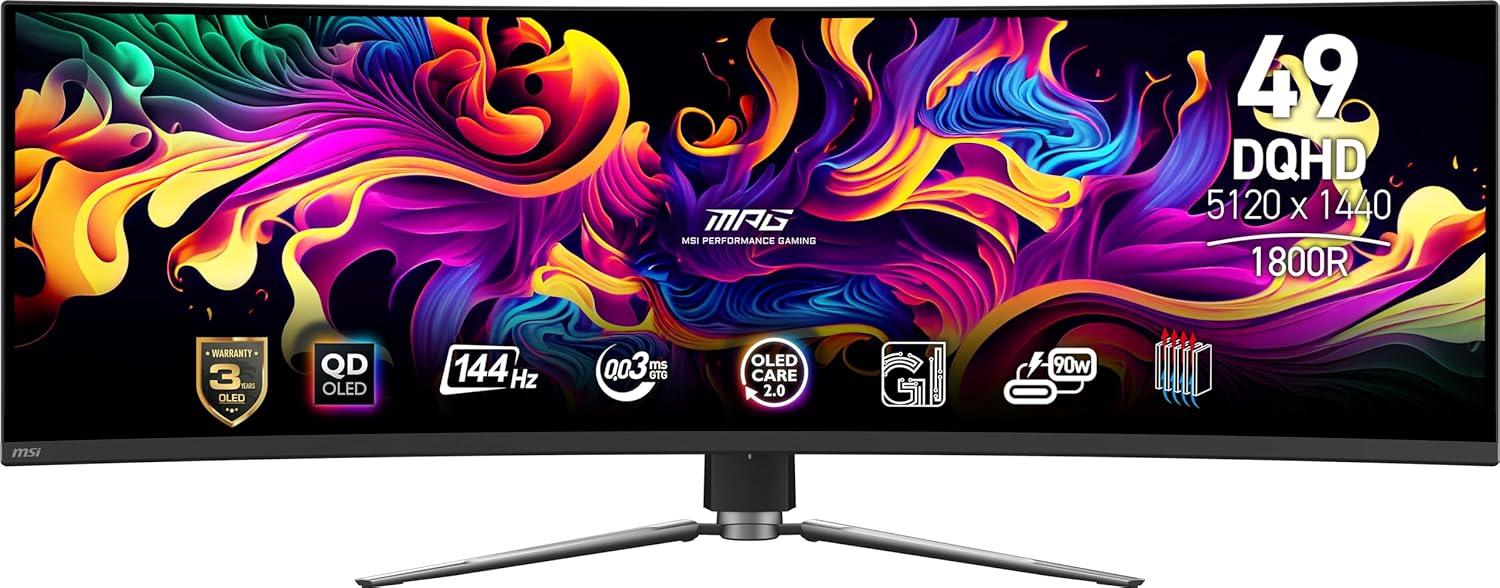
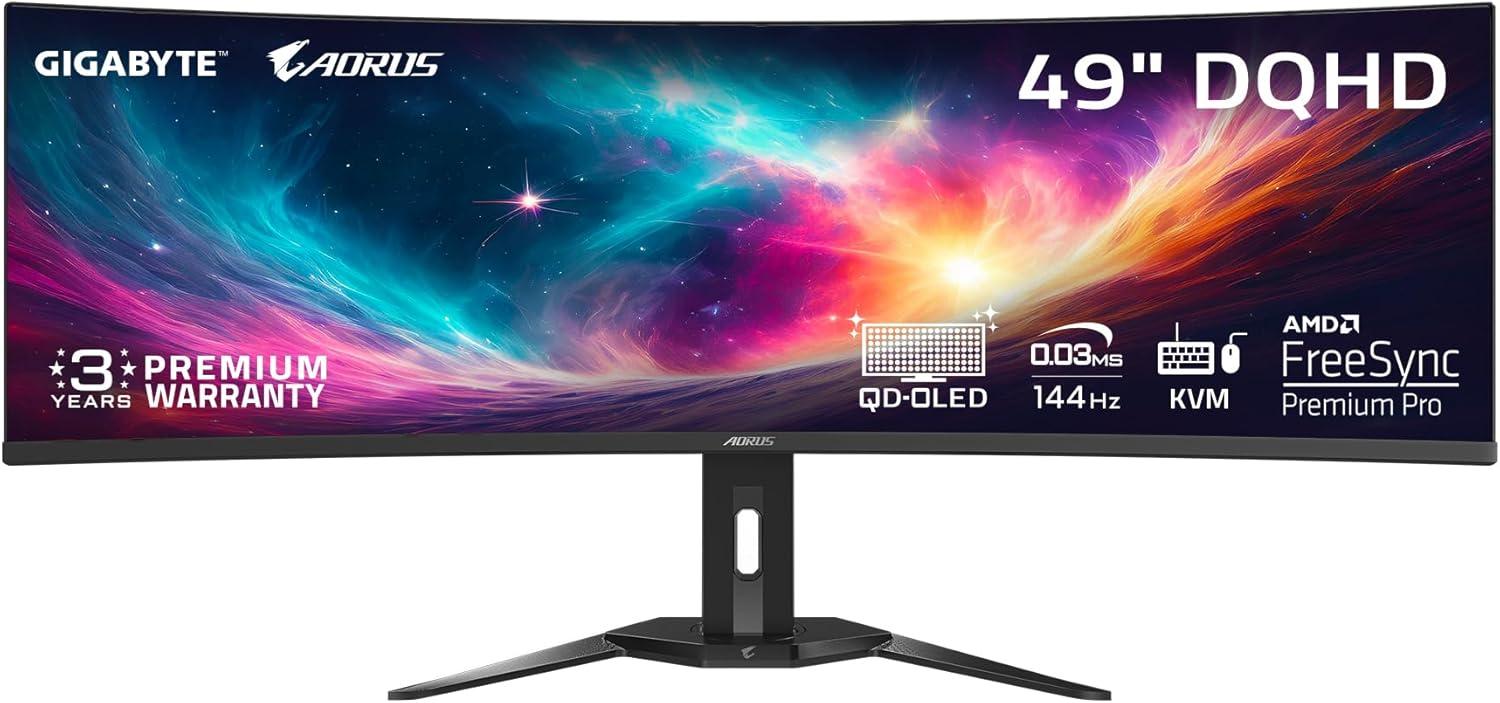
AORUS CO49DQ by GIGABYTE is a 48.90″ QD-OLED monitor with a resolution of 5120 × 1440 pixels and a refresh rate of up to 144 Hz. It supports a 10-bit color depth (true 10-bit panel without FRC), displays up to 1073741824 colors, and offers the following color space coverage: 153.10% sRGB , 99.00% DCI-P3 , 125.20% Adobe RGB , 127.40% NTSC. The panel delivers 250 nits of brightness, and can reach up to 1000 nits peak, has a static contrast ratio of 15000000:1, a response time of 0.03 ms. The panel is manufactured by Samsung. It has a pixel density of 108 PPI, with viewing angles of 178 ° (degrees)° horizontal and 178 ° (degrees)° vertical. The screen covers 91.27% of the front surface, and it features a 1800R curved panel. It has a screen coating and uses self-emissive QD-OLED technology, which does not require a backlight. Built-in 2 x 5 W (watts) speakers are included. Typical power consumption is 72.00 W.
General Work Usage
The GIGABYTE AORUS CO49DQ delivers a modest 69.1% productivity score, making it suitable for casual or part-time work tasks like email, browsing, or occasional document editing. It utilizes an QD-OLED panel offering high visual fidelity and rich contrast. While these panels excel in contrast, black levels, and color richness, they are prone to issues such as burn-in when static elements remain on screen for extended periods — a common scenario in office work with persistent UI components. Additionally, OLED panels may struggle to maintain full-screen brightness over time and can exhibit lower peak brightness compared to high-end IPS displays, reducing comfort in well-lit work environments. The monitor’s very high resolution of 5120×1440 ensures excellent workspace flexibility and visual clarity for office work and complex layouts. The pixel density of 108 ppi provides adequately crisp text without requiring scaling, though pixel edges may become noticeable when sitting close or working with fine content. With a brightness level of 250 nits, this monitor may appear dim in bright office settings, making it less suitable for environments with strong ambient light.
The GIGABYTE AORUS CO49DQ has color space coverage of: 153.10% sRGB , 99.00% DCI-P3 , 125.20% Adobe RGB , 127.40% NTSC, which gives this monitor exceptional color gamut coverage, making it a top-tier choice for professionals working in color-sensitive applications such as photo editing (Photoshop, Lightroom), video grading, or design production. Colors appear rich, consistent, and accurate across supported spaces. In addition, it features a true 10-bit panel, delivering extremely smooth gradients, precise tonal transitions, and a wide dynamic range. This combination ensures the highest standard for professional visual work.
The work performance-per-price score of 17.3% indicates that this monitor does not offer strong value for professional productivity use. Given both the modest work suitability score and weak value proposition, there are likely better alternatives in the same price class.
Gaming and Media Usage
The GIGABYTE AORUS CO49DQ achieves an outstanding 89.0% entertainment score, making it an excellent choice for immersive gaming, high-quality video playback, and fast-paced visual experiences. It utilizes an QD-OLED panel — a top-tier choice for gaming and media consumption. OLED technology delivers near-instantaneous pixel response, infinite contrast, and rich color vibrancy, making it ideal for cinematic content and fast-paced gameplay. However, OLED panels come with a few quirks: they are susceptible to burn-in from static HUD elements, may suffer from Automatic Brightness Limiting (ABL) in full-brightness scenes, and can have lower sustained brightness compared to premium LCDs — especially in well-lit environments. The monitor’s very high resolution of 5120×1440 offers excellent visual clarity, enhancing textures, fine details, and overall realism in both games and media. A capable GPU is recommended for optimal performance at this level. The monitor offers a high refresh rate of 144 Hz, providing fluid gameplay and improved responsiveness over standard 60 Hz displays, especially with a fast 0.03 msresponse time, making it suitable even for fast-paced gaming genres.
This monitor includes basic ergonomic features, sufficient for general use but potentially limiting in scenarios that involve prolonged screen time without additional adjustments, and offers excellent connectivity, supporting a wide range of usage scenarios and seamless integration with various devices and setups.Specific ergonomic adjustments and connectivity details can be found in the specifications section below.
Performance per Price
The gaming performance-per-price score of 15.6% indicates that this monitor does not offer strong value for gaming-focused users. Its respectable gaming suitability rating of 89.0% may still justify the price for certain use cases, though better-valued options exist.
With a performance-per-price score of just 20.4%, this monitor does not offer strong value in its category. Its decent quality rating of 81.7 pts gives it a reasonable edge for specific use cases — but better-priced alternatives may exist.
Monitor Information
| Manufacturer | GIGABYTE |
|---|---|
| Monitor Model | AORUS CO49DQ |
| Panel Manufacturer | Samsung |
| Current Price Amazon | $800 |
| Amazon Price Updated | 1 day, 11 hours ago. |
| Launch Date | 3 years, 6 months ago. |
| Monitor Available | True |
| Panel Size / Type | 48.90" / QD-OLED |
| Resolution | 5120 x 1440 pixels |
| Refresh Rate / Response Time | 144 Hz / 0.03 ms |
| Brightness / Contrast | 250 - 1000 nits / 15000000:1 |
| Color Depth / Coverage | 10-bit / DCI-P3: 99.00% |
| Pixel Density | 108 PPI |
| Viewing Angles | 178 ° (degrees)° / 178 ° (degrees)° |
| Screen Ratio / Curvature | Screen-to-Body Ratio: 91.27% , Curvature: 1800R |
| Speakers | 2 x 5 W (watts) |
| Power Consumption | Typical: 72.00 W |
Performance and Features Evaluation (Max 100 pts)
Calculated Performance and Performance per Price Scores
Additional Features and Information
| Connectivity | 1 x USB 3.0 (Type-B; upstream), 2 x USB 3.0 (Type-A; downstream), 1 x USB 3.2 (Type-C; upstream; 18W; DP Alt Mode), 2 x HDMI 2.1 (CEC), 1 x DisplayPort 1.4 (HBR3), 1 x 3.5 mm Audio Out |
|---|---|
| Ergonomic Adjustments | Swivel , Tilt , VESA Mount (100x100mm) |
| Included Accessories | DisplayPort cable, HDMI cable, USB-C cable |
| Additional Features | 6-axis Color Control, AMD FreeSync Premium Pro, Apply Picture Mode, Black Equalizer, Crosshair, Counter, Dashboard, Flicker-free technology, KVM Switch, Low Blue Light, OSD Sidekick, Picture-by-Picture, Picture-in-Picture, Timer |
AORUS CO49DQ Compared to Monitors with Similar Performance and Features
Monitor Quality & Features per Price Table
| Brand | Monitor (Desc) | Price (Desc) | Work (Desc) | Play (Desc) | Overall (Desc) | Work/$ (Desc) | Game/$ (Desc) | Overall/$ (Desc) |
|---|---|---|---|---|---|---|---|---|
| BenQ |
$600
|
0.0%
|
93.0%
|
70.0%
|
82.0%
|
31.0%
|
16.3%
|
27.3%
|
|
| BenQ |
$1500
|
↑
15.4%
|
92.9%
|
71.4%
|
81.3%
|
12.4%
|
6.7%
|
10.8%
|
|
| BenQ |
$850
|
0.0%
|
92.2%
|
70.8%
|
81.4%
|
21.7%
|
11.7%
|
19.2%
|
|
| Dell |
$408❗
|
0.0%
|
92.0%
|
68.6%
|
81.1%
|
45.1%
|
23.6%
|
39.8%
|
|
| ASUS |
$1720
|
0.0%
|
90.7%
|
71.8%
|
81.8%
|
10.5%
|
5.8%
|
9.5%
|
|
| ASUS |
$1599
|
0.0%
|
81.9%
|
77.4%
|
82.0%
|
10.2%
|
6.8%
|
10.3%
|
|
| GIGABYTE |
$538❗
|
↓
-4.6%
|
80.6%
|
81.5%
|
82.2%
|
30.0%
|
21.2%
|
30.6%
|
|
| LG |
$1082❗
|
↑
9.9%
|
80.4%
|
82.1%
|
81.7%
|
14.9%
|
10.6%
|
15.1%
|
|
| GIGABYTE |
$800
|
0.0%
|
69.1%
|
89.0%
|
81.7%
|
17.3%
|
15.6%
|
20.4%
|
Monitor Comparison and Detail Specifications Table
| Specification | Perf Chart | ||||||||
|---|---|---|---|---|---|---|---|---|---|
| Price |
$600
|
0.0%
|
$1500
|
↑
15.4%
|
$850
|
0.0%
|
$408❗
|
0.0%
|
$1720
|
0.0%
|
$1599
|
0.0%
|
$538❗
|
↓
-4.6%
|
$1082❗
|
↑
9.9%
|
$800
|
0.0%
|
| Brand | BenQ | BenQ | BenQ | Dell | ASUS | ASUS | GIGABYTE | LG | GIGABYTE |
| Size / Type | 28.20" / IPS | 27.00" / IPS | 31.50" / IPS | 31.50" / IPS | 32.00" / AHVA IPS | 26.90" / OLED | 31.50" / VA | 37.50" / IPS | 48.90" / QD-OLED |
| Resolution | 3840 × 2560 | 3840 × 2160 | 3840 × 2160 | 3840 × 2160 | 3840 × 2160 | 3840 × 2160 | 3840 × 2160 | 3840 × 1600 | 5120 × 1440 |
| Hz / Response | 60 Hz / 5.00 ms | 60 Hz / 5.00 ms | 60 Hz / 5.00 ms | 60 Hz / 5.00 ms | 65 Hz / 5.00 ms | 60 Hz / 0.10 ms | 160 Hz / 3.70 ms | 144 Hz / 4.00 ms | 144 Hz / 0.03 ms |
| Nits / Contrast | 350 nits / 1200:1 | 400 nits / 1000:1 | 350 nits / 2000:1 | 350 nits / 1000:1 | 600 nits / 1000:1 | 200 nits / 1000000:1 | 350 nits / 3000:1 | 400 nits / 1000:1 | 250 nits / 15000000:1 |
| Color / Coverage | 10-bit / DCI-P3: 95.00% | 10-bit / DCI-P3: 99.00% | 10-bit / DCI-P3: 98.00% | 10-bit / sRGB: 99.00% | 10-bit / DCI-P3: 99.00% | 10-bit / DCI-P3: 99.00% | 8-bit / DCI-P3: 93.00% | 10-bit / DCI-P3: 98.00% | 10-bit / DCI-P3: 99.00% |
| Pixel Density | 163 PPI | 163 PPI | 140 PPI | 140 PPI | 137 PPI | 163 PPI | 140 PPI | 111 PPI | 108 PPI |
| Curvature | Flat | Flat | Flat | Flat | Flat | Flat | 1500R | 2300R | 1800R |
| Backlight | W-LED | W-LED | Edge LED | W-LED | Mini LED | None | W-LED | W-LED | None |
| Coating | Anti-glare/Matte (3H) | Anti-glare/Matte (3H) | Anti-glare/Matte | Anti-glare/Matte (3H) | Anti-glare/Matte (3H) | Anti-glare/Matte (3H) | Anti-glare/Matte | Anti-glare/Matte (3H) | None |
| Speakers | 2 x 2 W (watts) | ❌ | 2 x 2 W (watts) | ❌ | 2 x 3 W (watts) | 2 x 3 W (watts) | 2 x 3 W (watts) | 2 x 7 W (watts) | 2 x 5 W (watts) |
| HDR | No data | HDR10, HLG (Hybrid Log Gamma) | HDR10, DisplayHDR 400 | HDR10 | HDR10, DisplayHDR 1000, HLG (Hybrid Log Gamma), Dolby Vision | No data | No data | HDR10, DisplayHDR 600 | No data |
| Local Dimming | ❌ | ❌ | ❌ | ❌ | Enabled (Mini LED) | ❌ | ❌ | ❌ | ❌ |
| Power | Typical: 34.00W , Max: 205.00W | Typical: 34.00W , Max: 210.00W | , Max: 220.00W | Typical: 30.60W , Max: 180.00W | Typical: 58.67W | Typical: 32.00W | Typical: 47.00W | Typical: 80.00W , Max: 210.00W | Typical: 72.00W |
| Panel Brand | BOE | No data | LG Display | No data | AU Optronics | JOLED | No data | LG Display | Samsung |
Monitor Specifications Table
| Brand | Monitor (Desc) | Size | Resolution | Panel Type | Bright. | Contrast | Depth | Hz | Resp. | Curvature |
|---|---|---|---|---|---|---|---|---|---|---|
| BenQ | 28.20" | 3840 × 2560 | IPS | 350 nits | 1200 : 1 | 10-bit | 60 Hz | 5.00 ms | Flat | |
| BenQ | 27.00" | 3840 × 2160 | IPS | 400 nits | 1000 : 1 | 10-bit | 60 Hz | 5.00 ms | Flat | |
| BenQ | 31.50" | 3840 × 2160 | IPS | 350 nits | 2000 : 1 | 10-bit | 60 Hz | 5.00 ms | Flat | |
| Dell | 31.50" | 3840 × 2160 | IPS | 350 nits | 1000 : 1 | 10-bit | 60 Hz | 5.00 ms | Flat | |
| ASUS | 32.00" | 3840 × 2160 | AHVA IPS | 600 nits | 1000 : 1 | 10-bit | 65 Hz | 5.00 ms | Flat | |
| ASUS | 26.90" | 3840 × 2160 | OLED | 200 nits | 1000000 : 1 | 10-bit | 60 Hz | 0.10 ms | Flat | |
| GIGABYTE | 31.50" | 3840 × 2160 | VA | 350 nits | 3000 : 1 | 8-bit | 160 Hz | 3.70 ms | 1500 mm | |
| LG | 37.50" | 3840 × 1600 | IPS | 400 nits | 1000 : 1 | 10-bit | 144 Hz | 4.00 ms | 2300 mm | |
| GIGABYTE | 48.90" | 5120 × 1440 | QD-OLED | 250 nits | 15000000 : 1 | 10-bit | 144 Hz | 0.03 ms | 1800 mm |
Add Comment on AORUS CO49DQ