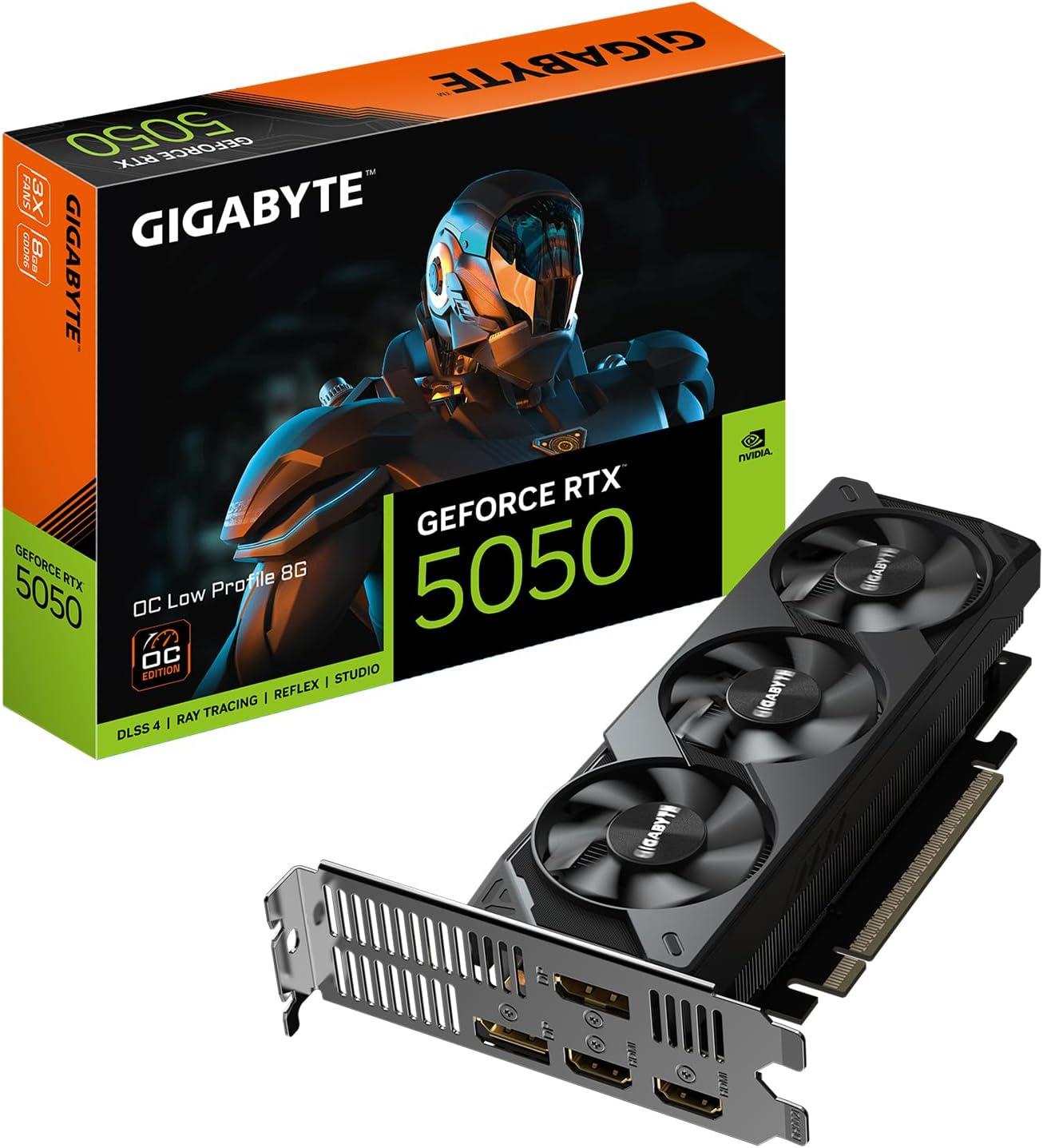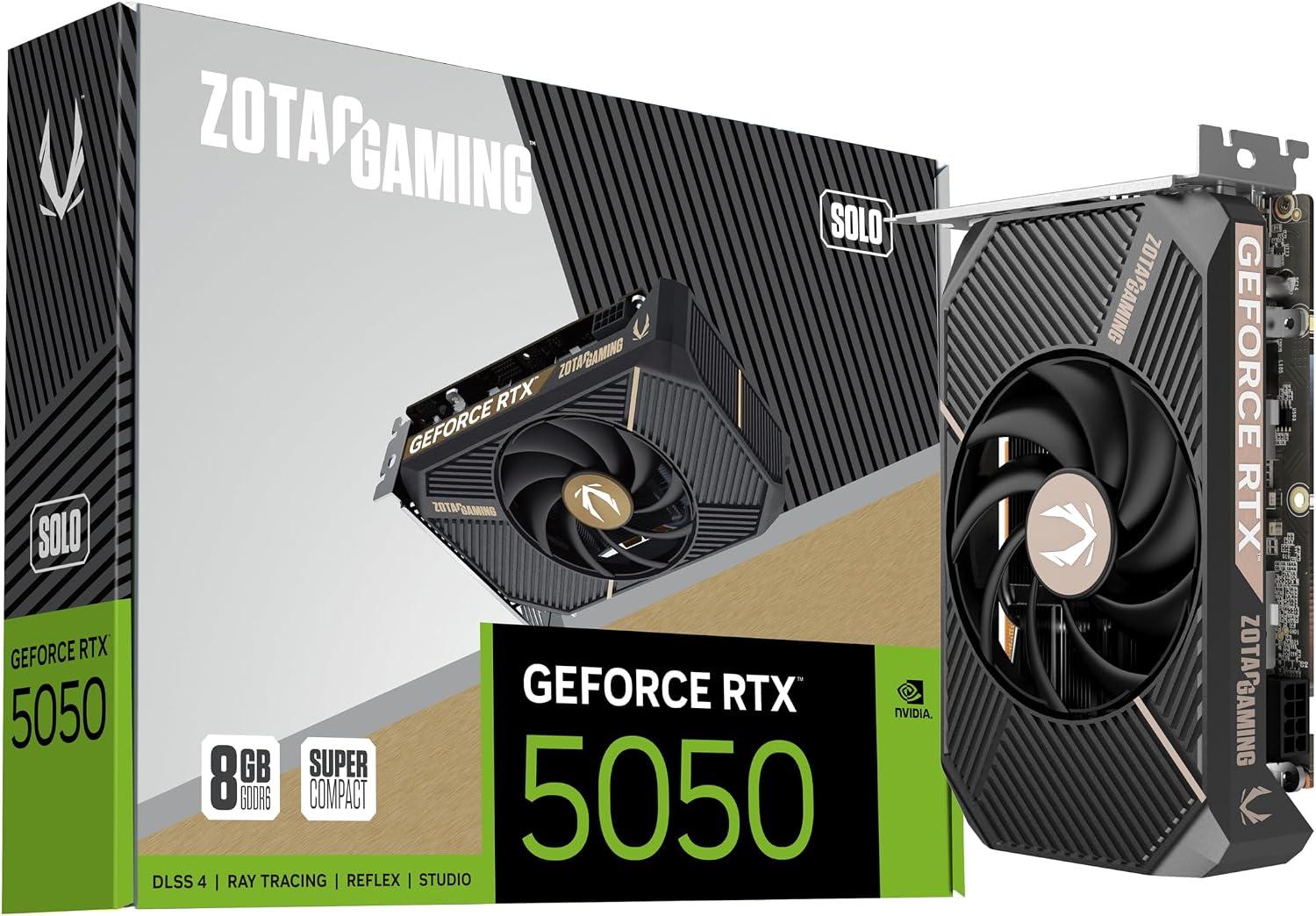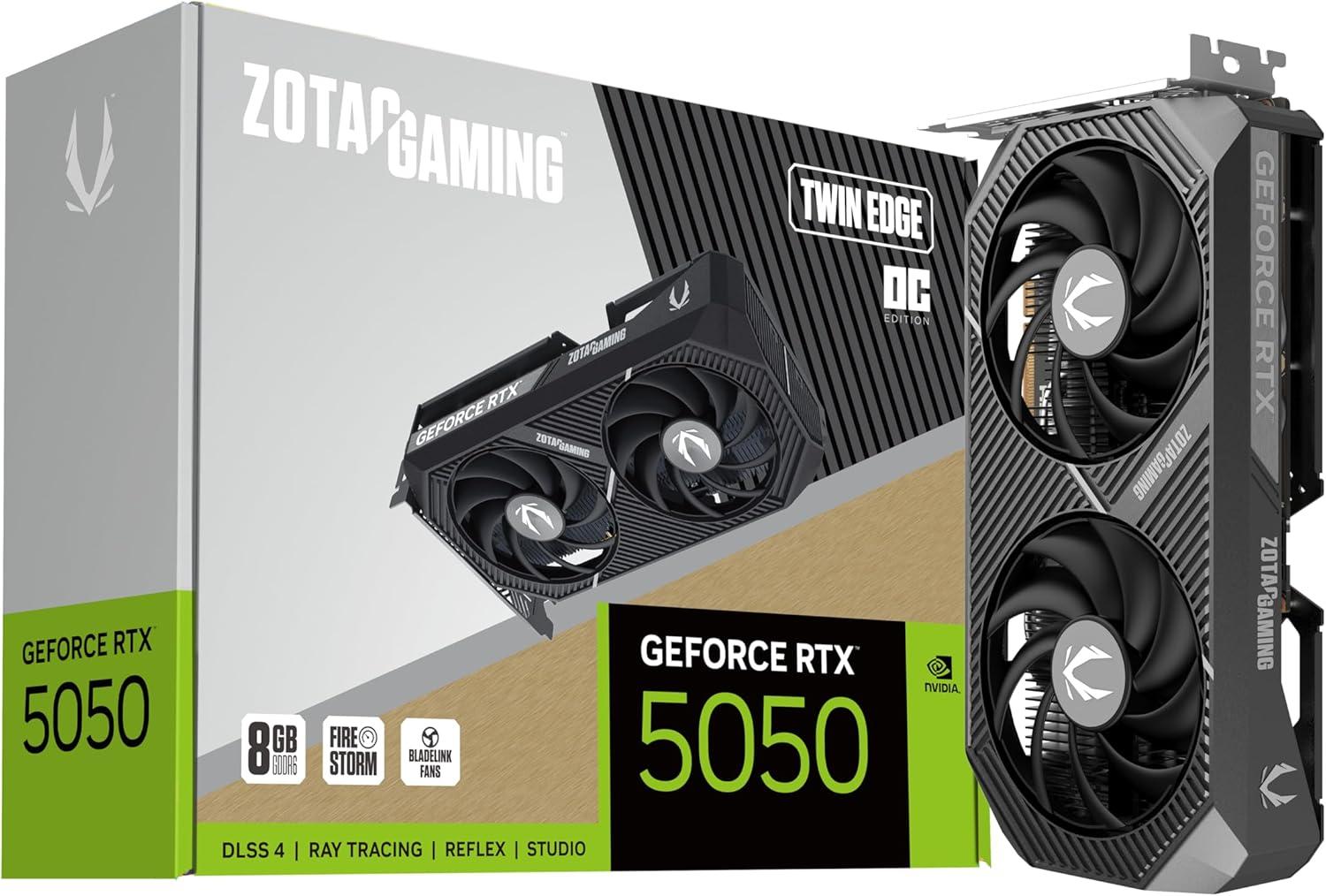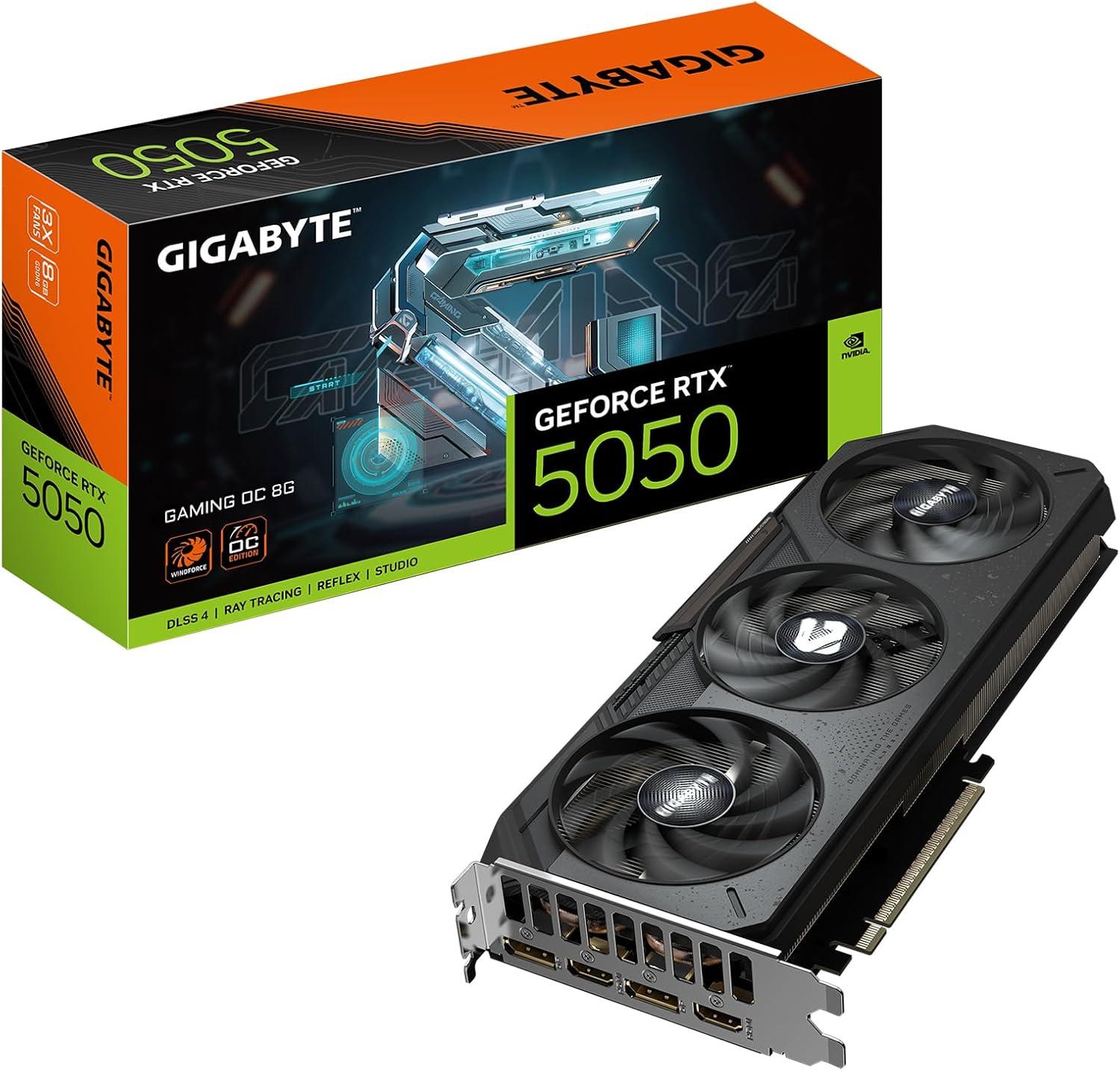
GIGABYTE GeForce RTX 5050 Gaming OC 8G
RTX 5050 Review & Specifications
The RTX 5050 is based on the Blackwell 2.0 architecture and manufactured using the 5 nm nm process node. It was launched approximately 1 year ago, originally priced at $249. It features 2560 cores, including 20 compute units (SMs), 80 texture mapping units (TMUs), and 32 render output units (ROPs). For ray tracing and AI-accelerated tasks, it also includes 20 dedicated RT cores and 80 Tensor cores, enabling advanced rendering and upscaling features where supported. It has a base clock of 2317 MHz and a boost clock reaching up to 2572 MHz. The RTX 5050 comes equipped with 8 GB of GDDR6 memory across a 128-bit bus. Memory runs at 2500 MHz and delivers a total memory bandwidth of 320 GB/s.
This GPU has a low thermal design power (TDP) of 130 W. It is generally compatible with almost all PC cases and is excellent for SFF and compact systems where heat dissipation is a concern.
RTX 5050 Performance
RTX 5050 is an entry-level graphics card with a relative gaming performance score of 30.62%. It performs well at 1080p and can handle 1440p with optimized settings or features like DLSS and FSR, though it's not suitable for 4K. Ideal for casual gamers or users who play occasionally on general-purpose PCs.
The RTX 5050 offers 8 GB of VRAM — a reasonable amount for its class. It performs well in 1080p gaming and modest 1440p workloads, though its lower compute performance may limit use of advanced settings or ray tracing. With support for DLSS, NVIDIA users can extend playability at higher resolutions. In creative tasks like photo editing or Full HD video, the GPU is adequate. Thanks to the NVIDIA ecosystem, this GPU is capable of basic AI experimentation, including inference with smaller models or quantized architectures — a good entry-level solution for developers interested in ML.
GIGABYTE GeForce RTX 5050 Gaming OC 8G provides excellent value at 77.5% efficiency. While its gaming performance is modest, it can still be a cost-effective solution for users with limited demands.
GPU General Information
| GPU Name | RTX 5050 |
|---|---|
| GPU Code Name | GB207 |
| Release Price | $249 |
| Selected Model | GIGABYTE GeForce RTX 5050 Gaming OC 8G |
| Launch Date | 1 year ago |
| GPU Available | True |
| Architecture | Blackwell 2.0 |
|---|---|
| Foundry | TSMC |
| Process | 5 nm |
| Transistors | 16900 million |
| Die Size | 149 mm² |
| Bus Interface | PCIe 5.0 x8 |
| TDP | 130 W |
| Cores | 2560 |
|---|---|
| CUs (SMs) | 20 |
| TMUs | 80 |
| ROPs | 32 |
| RT Cores | 20 |
| Tensor Cores | 80 |
| L1 Cache | 128 KB (per SM) |
| L2 Cache | 24 MB |
| Base Clock | 2317 MHz |
|---|---|
| Boost Clock | 2572 MHz |
| Memory Size - Type | 8 GB GDDR6 |
|---|---|
| Memory Bus Width | 128 bit |
| Memory Clock | 2500 MHz |
| Memory Bandwidth | 320 GB/s |
Graphics Card Information
| Name | GIGABYTE GeForce RTX 5050 Gaming OC 8G |
|---|---|
| Manufacturer | GIGABYTE |
| Graphics Card Available | True |
| Current Price Amazon | $310 |
| Amazon Price Updated | 1 hour ago |
| Factory GPU Clock | 2632 MHz |
| Memory Clock | 20 Gbps effective |
| Dimensions | L=280 W=117 H=40 mm |
| Power Connector | 1 x 8-pin |
Display Output
| DisplayPort 2.1b *2 HDMI 2.1b *2 |
Theoretical Performance
| Pixel Rate | 82.30 GPixel/s |
|---|---|
| Texture Rate | 205.80 GTexel/s |
| FP16 | 13.17 TFLOPS |
| FP32 | 13.17 TFLOPS |
| FP64 | 205.82 GFLOPS |
Gaming Performance Chart
RTX 5050 Compared to Similar Performance GPUs
GPU Price / Performance Table
GPU (Desc)
Price (Desc)
Gaming_1080p (Desc)
Gaming_1440p (Desc)
Gaming_2160p (Desc)
Game_1440p/Price (Desc)
$500
|
↓
-3.7%
32.8%
26.2%
20.7%
51.9%
$350
|
↑
6.1%
30.9%
24.9%
19.9%
70.4%
$369
|
0.0%
28.3%
24.6%
22.2%
66.1%
$350
|
0.0%
29.4%
24.4%
21.1%
69.0%
$310
|
0.0%
30.6%
24.3%
18.9%
77.5%
$329❗
|
↑
9.7%
29.9%
23.9%
18.4%
71.9%
$321
|
0.0%
30.2%
23.8%
18.6%
73.4%
$549
|
0.0%
28.6%
22.6%
17.6%
40.7%
$285❗
|
0.0%
25.9%
22.4%
17.8%
77.9%
| GPU (Desc) | Price (Desc) | Gaming_1080p (Desc) | Gaming_1440p (Desc) | Gaming_2160p (Desc) | Game_1440p/Price (Desc) |
|---|---|---|---|---|---|
|
$500
|
↓
-3.7%
|
32.8%
|
26.2%
|
20.7%
|
51.9%
|
|
|
$350
|
↑
6.1%
|
30.9%
|
24.9%
|
19.9%
|
70.4%
|
|
|
$369
|
0.0%
|
28.3%
|
24.6%
|
22.2%
|
66.1%
|
|
|
$350
|
0.0%
|
29.4%
|
24.4%
|
21.1%
|
69.0%
|
|
|
$310
|
0.0%
|
30.6%
|
24.3%
|
18.9%
|
77.5%
|
|
|
$329❗
|
↑
9.7%
|
29.9%
|
23.9%
|
18.4%
|
71.9%
|
|
|
$321
|
0.0%
|
30.2%
|
23.8%
|
18.6%
|
73.4%
|
|
|
$549
|
0.0%
|
28.6%
|
22.6%
|
17.6%
|
40.7%
|
|
|
$285❗
|
0.0%
|
25.9%
|
22.4%
|
17.8%
|
77.9%
|
GPU Specification Table
| GPU (Desc) | Architecture | Shader/TMU/ROP/RT | Base/Boost Clock | Memory | Mem Clock/Bandwidth | TDP |
|---|---|---|---|---|---|---|
| RX 7600 XT | Navi 33 / 6 nm / RDNA 3.0 | 2048 / 128 / 64 / 32 | 1980 MHz / 2755 MHz | 16 GB GDDR6 / 128 bit | 2250 MHz / 288 GB/s | 190 W |
| RTX 4060 | AD107 / 5 nm nm / Ada Lovelace | 3072 / 96 / 48 / 24 | 1830 MHz / 2460 MHz | 8 GB GDDR6 / 128 bit | 2125 MHz / 272 GB/s | 115 W |
| Arc A770 | DG2-512 / 6 nm / Xe HPG | 4096 / 256 / 128 / 32 | 2100 MHz / 2400 MHz | 16 GB GDDR6 / 256 bit | 2000 MHz / 512 GB/s | 225 W |
| RTX 2070 SUPER | TU104 / 12 nm nm / Turing | 2560 / 160 / 64 / 40 | 1605 MHz / 1770 MHz | 8 GB GDDR6 / 256 bit | 1750 MHz / 448 GB/s | 215 W |
| RTX 5050 | GB207 / 5 nm nm / Blackwell 2.0 | 2560 / 80 / 32 / 20 | 2317 MHz / 2572 MHz | 8 GB GDDR6 / 128 bit | 2500 MHz / 320 GB/s | 130 W |
| RX 6650 XT | Navi 23 / 7 nm / RDNA 2.0 | 2048 / 128 / 64 / 32 | 2055 MHz / 2635 MHz | 8 GB GDDR6 / 128 bit | 2190 MHz / 280 GB/s | 176 W |
| RX 7600 | Navi 33 / 6 nm / RDNA 3.0 | 2048 / 128 / 64 / 32 | 1720 MHz / 2655 MHz | 8 GB GDDR6 / 128 bit | 2250 MHz / 288 GB/s | 165 W |
| RX 6600 XT | Navi 23 / 7 nm / RDNA 2.0 | 2048 / 128 / 64 / 32 | 1968 MHz / 2589 MHz | 8 GB GDDR6 / 128 bit | 2000 MHz / 256 GB/s | 160 W |
| Arc A750 | DG2-512 / 6 nm / Xe HPG | 3584 / 224 / 112 / 28 | 2050 MHz / 2400 MHz | 8 GB GDDR6 / 256 bit | 2000 MHz / 512 GB/s | 225 W |
Graphics Cards Based on the RTX 5050 GPU
| Specification | Perf Chart | |||||
|---|---|---|---|---|---|---|
| Price |
$310
|
0.0%
|
$315
|
0.0%
|
$324❗
|
↑
6.2%
|
$300
|
0.0%
|
$268❗
|
↓
-10.5%
|
$241❗
|
↓
-19.6%
|
| GPU | Nvidia RTX 5050 | Nvidia RTX 5050 | Nvidia RTX 5050 | Nvidia RTX 5050 | Nvidia RTX 5050 | Nvidia RTX 5050 |
| Manufacturer | GIGABYTE | MSI | MSI | GIGABYTE | MSI | ZOTAC |
| Chip/Process/Arch | GB207 / 5 nm nm / Blackwell 2.0 | GB207 / 5 nm nm / Blackwell 2.0 | GB207 / 5 nm nm / Blackwell 2.0 | GB207 / 5 nm nm / Blackwell 2.0 | GB207 / 5 nm nm / Blackwell 2.0 | GB207 / 5 nm nm / Blackwell 2.0 |
| Cores/TMU/ROP/RT | 2560 / 80 / 32 / 20 | 2560 / 80 / 32 / 20 | 2560 / 80 / 32 / 20 | 2560 / 80 / 32 / 20 | 2560 / 80 / 32 / 20 | 2560 / 80 / 32 / 20 |
| Base/Boost MHz | 2317 MHz / 2572 MHz | 2317 MHz / 2572 MHz | 2317 MHz / 2572 MHz | 2317 MHz / 2572 MHz | 2317 MHz / 2572 MHz | 2317 MHz / 2572 MHz |
| Factory OC MHz | 2632 MHz | 2647 MHz | 2587 MHz | 2587 MHz | 2617 MHz | 2602 MHz |
| VRAM / Bus | 8 GB GDDR6 / 128 bit | 8 GB GDDR6 / 128 bit | 8 GB GDDR6 / 128 bit | 8 GB GDDR6 / 128 bit | 8 GB GDDR6 / 128 bit | 8 GB GDDR6 / 128 bit |
| Mem Clock/Band | 2500 MHz / 320 GB/s | 2500 MHz / 320 GB/s | 2500 MHz / 320 GB/s | 2500 MHz / 320 GB/s | 2500 MHz / 320 GB/s | 2500 MHz / 320 GB/s |
| TDP | 130 W | 130 W | 130 W | 130 W | 130 W | 130 W |
| Power Connector | 1 x 8-pin | 1 x 8-pin | 1 x 8-pin | 1 x 8-pin | 1 x 8-pin | 1 x 8-pin |
| Dimensions | L=280 W=117 H=40 mm | 202 x 120 x 41 mm | 197 x 120 x 41 mm | L=182 W=69 H=36 mm | 197 x 120 x 40 mm | 220.5 x 120.25 x 41.6mm |
Add Comment on GIGABYTE GeForce RTX 5050 Gaming OC 8G