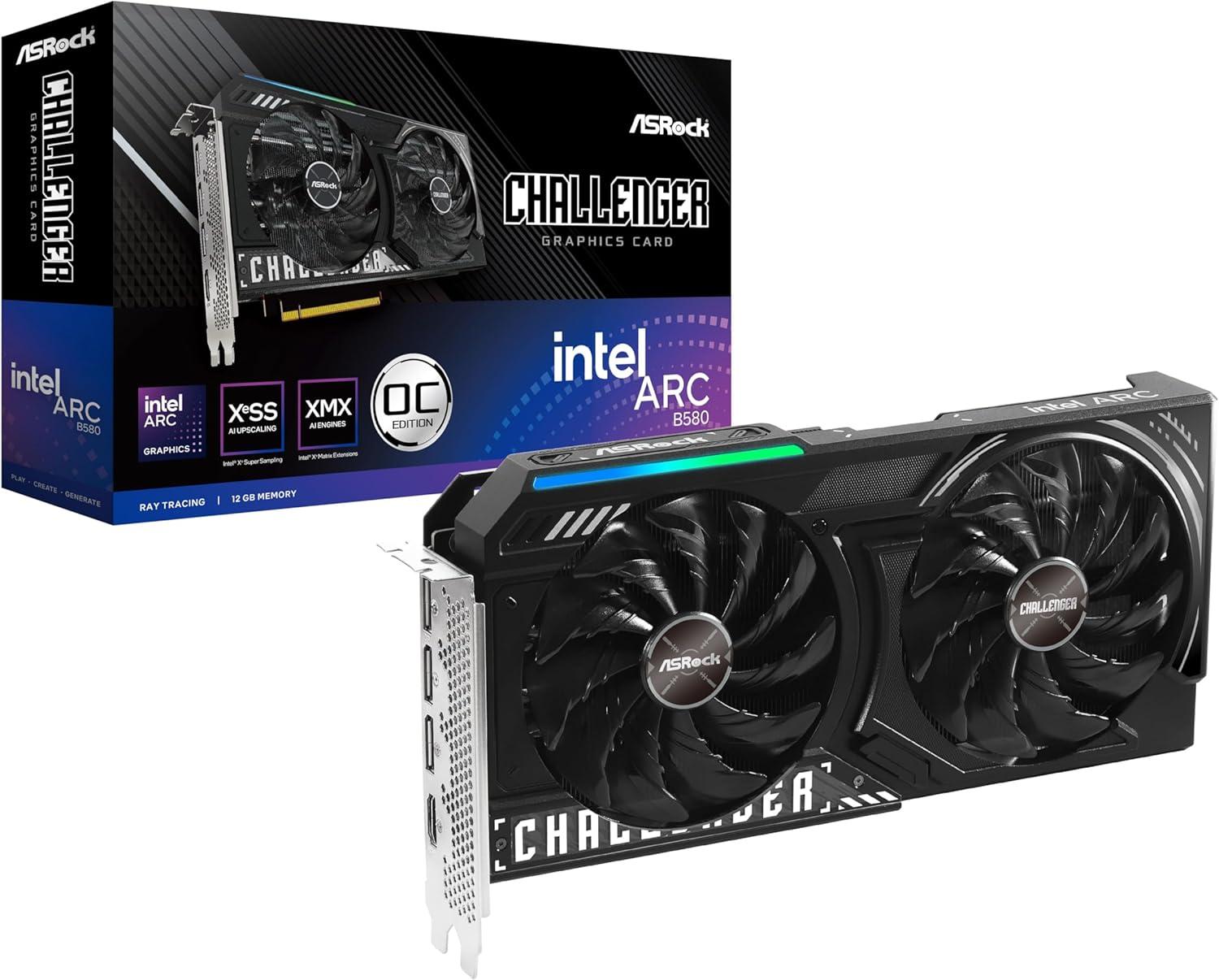
Arc B580
Arc B580 Review & Specifications
The Arc B580 is based on the Xe2 architecture and manufactured using the 5 nm process node. It was launched approximately 1 year, 6 months ago, originally priced at $249. It features 2560 cores, including 24 compute units (SMs), 160 texture mapping units (TMUs), and 80 render output units (ROPs). For ray tracing and AI-accelerated tasks, it also includes 20 dedicated RT cores and 160 Tensor cores, enabling advanced rendering and upscaling features where supported. It has a base clock of 2670 MHz and a boost clock reaching up to 2670 MHz. The Arc B580 comes equipped with 12 GB of GDDR6 memory across a 192-bit bus. Memory runs at 2375 MHz and delivers a total memory bandwidth of 456 GB/s.
This GPU has a low thermal design power (TDP) of 190 W. It is generally compatible with almost all PC cases and is excellent for SFF and compact systems where heat dissipation is a concern.
Arc B580 Performance
Arc B580 is an entry-level graphics card with a relative gaming performance score of 32.62%. It performs well at 1080p and can handle 1440p with optimized settings or features like DLSS and FSR, though it's not suitable for 4K. Intended for for casual gamers or users who play occasionally on general-purpose PCs.
The Arc B580 has a moderate VRAM size of 12 GB, which aligns well with its performance class. It is well-suited for 1080p gaming at high settings and 1440p gaming at medium to high settings, depending on the game’s optimization and graphics demands. While capable in rasterized workloads, enabling ray tracing at higher resolutions can quickly consume available VRAM and reduce performance. Upscaling technologies like DLSS or FSR can help improve frame rates, but may come with a noticeable reduction in visual quality. The VRAM capacity is adequate for light to moderate content creation tasks, such as editing Full HD or QHD video, working with smaller assets in 3D environments, and using tools like Photoshop or Premiere Pro for general workloads. In the context of AI and machine learning, this GPU can handle lightweight inference tasks and basic model training. However, users working with large datasets or complex architectures may find the memory insufficient, leading to slowdowns or compatibility issues. This GPU remains a good option for gamers, casual creators, and students exploring AI.
Arc B580 provides excellent value at 82.9% efficiency. While its gaming performance is modest, it can still be a cost-effective solution for users with limited demands.
General Information
| GPU Name | Arc B580 |
|---|---|
| GPU Code Name | BMG-G21 |
| Release Price | $249 |
| Selected Model | Intel Arc B580 Steel Legend 12GB OC Graphics Card, 2800 MHz GPU Clock, 12GB GDDR6, DisplayPort 2.1, HDMI 2.1a, Triple Fan Cooling, Polychrome SYNC |
| Current Price Amazon | $320❗N/A |
| Amazon Price Updated | 3 weeks ago |
| Launch Date | 1 year, 6 months ago |
| GPU Available | False |
| Architecture | Xe2 |
|---|---|
| Process | 5 |
| Transistors | 19600 million |
| Bus Interface | PCIe 4.0 x8 |
| TDP | 190 W |
| Cores | 2560 |
|---|---|
| CUs (SMs) | 24 |
| TMUs | 160 |
| ROPs | 80 |
| RT Cores | 20 |
| Tensor Cores | 160 |
| Base Clock | 2670 MHz |
|---|---|
| Boost Clock | 2670 MHz |
| Memory Size - Type | 12 GB GDDR6 |
|---|---|
| Memory Bus Width | 192 bit |
| Memory Clock | 2375 MHz |
| Memory Bandwidth | 456 GB/s |
Theoretical Performance
| Pixel Rate | 84.96 GPixel/s |
|---|---|
| Texture Rate | 427.20 GTexel/s |
| FP16 | 27.34 TFLOPS |
| FP32 | 13.67 TFLOPS |
| FP64 | 1709.00 GFLOPS |
Gaming Performance Chart
Arc B580 Compared to Similar Performance GPUs
GPU Price / Performance Table
| GPU (Desc) | Price (Desc) | Gaming_1080p (Desc) | Gaming_1440p (Desc) | Gaming_2160p (Desc) | Game_1440p/Price (Desc) |
|---|---|---|---|---|---|
|
$552❗
|
↑
1.3%
|
38.5%
|
31.7%
|
25.7%
|
51.6%
|
|
|
$345
|
0.0%
|
39.1%
|
31.7%
|
24.3%
|
82.6%
|
|
|
$350
|
0.0%
|
38.8%
|
31.0%
|
24.0%
|
79.6%
|
|
|
$400❗
|
↑
1.3%
|
36.8%
|
30.2%
|
24.6%
|
68.0%
|
|
|
$320❗
|
↑
3.2%
|
32.6%
|
29.5%
|
25.0%
|
82.9%
|
|
|
$350
|
0.0%
|
35.5%
|
29.4%
|
24.0%
|
75.5%
|
|
|
$785
|
↑
105.1%
|
33.9%
|
28.1%
|
24.4%
|
32.1%
|
|
|
$285
|
↓
-1.7%
|
33.1%
|
27.1%
|
23.4%
|
85.4%
|
|
|
$500
|
0.0%
|
32.8%
|
26.2%
|
20.7%
|
47.1%
|
GPU Specification Table
| GPU (Desc) | Architecture | Shader/TMU/ROP/RT | Base/Boost Clock | Memory | Mem Clock/Bandwidth | TDP |
|---|---|---|---|---|---|---|
| RX 6750 XT | Navi 22 / 7 nm / RDNA 2.0 | 2560 / 160 / 64 / 40 | 2150 MHz / 2600 MHz | 12 GB GDDR6 / 192 bit | 2250 MHz / 432 GB/s | 250 W |
| RTX 4060 Ti 8GB | AD106 / 5 nm nm / Ada Lovelace | 4352 / 136 / 48 / 34 | 2310 MHz / 2535 MHz | 8 GB GDDR6 / 128 bit | 2250 MHz / 288 GB/s | 160 W |
| RTX 5060 | GB206 / 5 nm nm / Blackwell 2.0 | 3840 / 120 / 48 / 30 | 2280 MHz / 2497 MHz | 8 GB GDDR7 / 128 bit | 1750 MHz / 448 GB/s | 145 W |
| RX 6700 XT | Navi 22 / 7 nm nm / RDNA 2.0 | 2560 / 160 / 64 / 40 | 2321 MHz / 2581 MHz | 12 GB GDDR6 / 192 bit | 2000 MHz / 384 GB/s | 230 W |
| Arc B580 | BMG-G21 / 5 nm / Xe2 | 2560 / 160 / 80 / 20 | 2670 MHz / 2670 MHz | 12 GB GDDR6 / 192 bit | 2375 MHz / 456 GB/s | 190 W |
| RTX 3060 Ti | GA104 / 8 nm nm / Ampere | 4864 / 152 / 80 / 38 | 1410 MHz / 1665 MHz | 8 GB GDDR6 / 256 bit | 1750 MHz / 448 GB/s | 200 W |
| RTX 2080 SUPER | TU104 / 12 nm / Turing | 3072 / 192 / 64 / 48 | 1650 MHz / 1815 MHz | 8 GB GDDR6 / 256 bit | 1650 MHz / 496 GB/s | 250 W |
| RTX 2080 | TU104 / 12 nm nm / Turing | 2944 / 184 / 64 / 46 | 1515 MHz / 1710 MHz | 8 GB GDDR6 / 256 bit | 1750 MHz / 448 GB/s | 215 W |
| RX 7600 XT | Navi 33 / 6 nm nm / RDNA 3.0 | 2048 / 128 / 64 / 32 | 1980 MHz / 2755 MHz | 16 GB GDDR6 / 128 bit | 2250 MHz / 288 GB/s | 190 W |
Add Comment on Arc B580